Showing posts with label books. Show all posts
Showing posts with label books. Show all posts
Wednesday, 31 October 2007
Sanjay Subrahmanyam on Naipaul
Sanjay Subrahmanyam has some very interesting insights into Naipaul and his views in his review of Naipaul's latest book of essays in the London Review of Books here.


Monday, 30 July 2007
The Forgotten War Against Chinese Americans
An interesting review of Jean Pfaelzer's book at the NYT.
IZ
“Driven Out” cites records of more than 100 roundups, pogroms, expulsions and ethnic cleansings (to use Pfaelzer’s various terms for these actions) in which white Westerners united to drive the Chinese out of their communities from 1850 to 1906. They used warnings, arson, boycotts and violence to achieve their goal. In many circumstances, labor organizations led the campaigns, casting the Chinese as competitors for jobs and depressors of wages. But middle-class civic leaders often acted in alliance with workers.
IZ
Wednesday, 27 June 2007
The Hathor Legacy
Came across an interesting site: 'The Hathor Legacy'. Its essentially posting on books, film and some general cultural issues from a feminist perspective. What's interesting is the authors' interest in science fiction/fantasy genre fiction. Reading through a few of the posts, (and the comments) such as this one on the "legacy" of Octavia Butler proved illuminating and so up it goes on my blog roll.
And now I have a new book to look out for: 'Zahrah the Windseeker' by Nnedi Nkemdili Okorafor-Mbachu. Looks interesting.
IZ
And now I have a new book to look out for: 'Zahrah the Windseeker' by Nnedi Nkemdili Okorafor-Mbachu. Looks interesting.
IZ
Sunday, 10 June 2007
Sorted Books and xkcd
Thanks to madgraceflint for the link on her blog to this site and the Sorted Books Project.
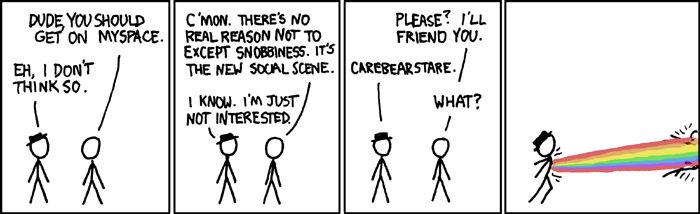
She also linked to this comic on the xkcd web-comic site, which is one of the best web-comics out there in my opinion, but which, for some reason, I haven't yet linked to on this blog.
To make up for this error I bring you one of my favourite xkcd comics (click on it to see a bigger version):

IZ
She also linked to this comic on the xkcd web-comic site, which is one of the best web-comics out there in my opinion, but which, for some reason, I haven't yet linked to on this blog.
To make up for this error I bring you one of my favourite xkcd comics (click on it to see a bigger version):
IZ
Thursday, 10 May 2007
The Book Challenge
Those who are wont to notice such things may well have noticed that the Zokuto metre has now been set to reflect a target of 75 books. Setting myself a challenge of reading 65 books in the year was looking to be far too easy so I have upgraded to... THE 75 BOOK CHALLENGE!!!
Its still a bit of a cop out though as I'm still waaaay ahead of the required book-read-rate! If I was not such a wuss I would go for the 100 book challenge....
Hmm. Let me get done with my exams and we'll see.
IZ
Its still a bit of a cop out though as I'm still waaaay ahead of the required book-read-rate! If I was not such a wuss I would go for the 100 book challenge....
Hmm. Let me get done with my exams and we'll see.
IZ
Thursday, 3 May 2007
Book: The Devil's Game
Now here is a book to look out for. It chronicles the American campaign to promote Islamic fundamentalism in the middle east since the 50s, wanting to use it as an ideological weapon against 'godless communism'. I think I'll get right on to amazon and order it today.
IZ
IZ
Monday, 30 April 2007
Alastair Reynolds Lives! Kurt Vonnegut, Alas, Does Not.
Came across a random article on the physicist turned sci-fi novelist, Alastair Reynolds. I've read 4 of his books and can see why he's been one of the key components of the British "space opera renaissance" of the last few years (other contributors include Neal Asher, Charles Stross, Peter Hamilton and of course the grand masters Iain Banks and Ken MacLeod).
I'm looking forward to reading his new book 'The Prefect', though I don't imagine it will be any time soon, what with work and a huge backlog of stuff to read.
On another note, the brilliant satirist and novelist Kurt Vonnegut has passed away. To learn more about him you can follow the link to his obituary on bbc.com. I thought I'd just put down a comment of two about some of his stuff that I've read.
The first book of his that I read was 'Breakfast of Champions' back when I was doing my A Levels in Karachi. I remember picking it up at a friend's house, just meaning to browse and then getting caught up. Its very elegantly written, like all of his best stuff. At the same time I was amazed. I didn't know it was possible to write like this! Breaking all the conventions of plot and characterisation and narrative, and yet, still write something so interesting. I remember when I finished the book I was crying. At the time I found the book unremittingly bleak, though a recent rereading of it found it less so.
My favourite Vonnegut book has to be 'Slaughter House 5'. It is based on Vonnegut's own experience in the Second World War. In the introduction, Vonnegut describes how he was a prisoner of war in 1945, and was held at Dresden where he and other prisoners were housed in a Meat processing plant which had been converted to hold prisoners because there was no meat to be found at this late stage of the war in Germany. He describes how Dresden was fire-bombed (many now hold the fire-bombing of Dresden as a war crime because it was not a military target and led to the deaths of between 20,000 - 60,000 civilians, with some estimates going as high as 160,000) which he survived because the slaughter-house in which he and his fellow prisoners were in was untouched while the next building over which housed nuns who were war refugees was completely destroyed. After the bombing he and the other prisoners were put to work pulling out bodies from the wreckage. There is one horrific detail (out of the many) which sticks in my mind, which is his description of another POW - a Maori from New Zealand retching till he choked to death at the sight of the carnage. Vonnegut builds on these and other experiences to write about fate, free will and human nature. The climax of the novel comes not with the fire-bombing, but in the aftermath with the hanging of a man for looting in the ruins of the city, a rather senseless tragedy in the face of everything that has come before and that is to follow.
As Vonnegut says 'So it goes'.
IZ
I'm looking forward to reading his new book 'The Prefect', though I don't imagine it will be any time soon, what with work and a huge backlog of stuff to read.
On another note, the brilliant satirist and novelist Kurt Vonnegut has passed away. To learn more about him you can follow the link to his obituary on bbc.com. I thought I'd just put down a comment of two about some of his stuff that I've read.
The first book of his that I read was 'Breakfast of Champions' back when I was doing my A Levels in Karachi. I remember picking it up at a friend's house, just meaning to browse and then getting caught up. Its very elegantly written, like all of his best stuff. At the same time I was amazed. I didn't know it was possible to write like this! Breaking all the conventions of plot and characterisation and narrative, and yet, still write something so interesting. I remember when I finished the book I was crying. At the time I found the book unremittingly bleak, though a recent rereading of it found it less so.
My favourite Vonnegut book has to be 'Slaughter House 5'. It is based on Vonnegut's own experience in the Second World War. In the introduction, Vonnegut describes how he was a prisoner of war in 1945, and was held at Dresden where he and other prisoners were housed in a Meat processing plant which had been converted to hold prisoners because there was no meat to be found at this late stage of the war in Germany. He describes how Dresden was fire-bombed (many now hold the fire-bombing of Dresden as a war crime because it was not a military target and led to the deaths of between 20,000 - 60,000 civilians, with some estimates going as high as 160,000) which he survived because the slaughter-house in which he and his fellow prisoners were in was untouched while the next building over which housed nuns who were war refugees was completely destroyed. After the bombing he and the other prisoners were put to work pulling out bodies from the wreckage. There is one horrific detail (out of the many) which sticks in my mind, which is his description of another POW - a Maori from New Zealand retching till he choked to death at the sight of the carnage. Vonnegut builds on these and other experiences to write about fate, free will and human nature. The climax of the novel comes not with the fire-bombing, but in the aftermath with the hanging of a man for looting in the ruins of the city, a rather senseless tragedy in the face of everything that has come before and that is to follow.
As Vonnegut says 'So it goes'.
IZ
Monday, 16 April 2007
On Not Keeping Up With the Joneses
Well when I started this blog I was hoping that I would jot down a few notes about each book I read... as it turns out things haven't really worked out that way. I would like to think that the tremendous rate at which I devour books leaves me little time for the difficult task of blogging about them, but the little itty bitty part of me that occasionally pricks my conscience into speaking the truth would have us believe that I have been seriously remiss in my duties and not a little lazy about this.
mea culpa.
On the up side a quick glance at the Zokuto meter in the margin of my blog tells me that I've now read 27 books this year already (making that 41% of my pledged reading total) while a mere 107 days (just under 30% of the year) have passed, so I am well on the way of achieving my targets.
Hmm... maybe my targets are not ambitious enough. Maybe I should shoot for... oh, say 75 books (36% done) or even... heaven forfend... 100 books!!! No, that would be a little too ambitious. I'll have a ponder over the 75 mark. In the meanwhile I'll try and get more written about the books I'm reading.
mea culpa.
On the up side a quick glance at the Zokuto meter in the margin of my blog tells me that I've now read 27 books this year already (making that 41% of my pledged reading total) while a mere 107 days (just under 30% of the year) have passed, so I am well on the way of achieving my targets.
Hmm... maybe my targets are not ambitious enough. Maybe I should shoot for... oh, say 75 books (36% done) or even... heaven forfend... 100 books!!! No, that would be a little too ambitious. I'll have a ponder over the 75 mark. In the meanwhile I'll try and get more written about the books I'm reading.
Tuesday, 27 March 2007
Book Shelves as Art!
I came across a link to this article on a LibraryThing forum. I always thought there was something aesthetically pleasing about book shelves but I must say this work of art looks rather nice. Apparently there actually are some people who shelve their books by colour!
As for me, I first need to get more shelf space before I can get really creative with my shelving policy!
IZ
As for me, I first need to get more shelf space before I can get really creative with my shelving policy!
IZ
Wednesday, 7 March 2007
The Zokutou Word Meter!
This is a pretty cool little thingamajig. Its a counter that you can place into your posts/projects etc. It was originally designed to display the proportion of words you have written for a project but is currently being popularly used by LibraryThingers to count off books they have read in a year vs. how much they are aiming to read. This has been combined with the "50 book challenge": the challenge to read 50 books in a calender year (or 75, or 100 etc.)
In 2004 I read 25 books (cover to cover). In 2005 I read 58. In 2006 I read 87 (86 of which were fiction!) which is kind of an excessive amount. So what should I aim for this year? I reckon about 50-odd fiction books and say around 10-odd non-fiction books, so let's say 65 books this year as a tough but reachable target.
Of course the reason this is difficult is that I'm doing a lot of reading for courses/research etc. which is not cover to cover and which takes up a good deal of reading time and mental energy. In that light 65 seems kind of ambitious, but oh well. Lets see what happens.
So far I have read 18 books in 2007. My Zokuto meter is as follows:
Hmm. I wonder what other use we can put this meter to? Well if 66 days of the year have passed. Maybe we can make another meter that will allow us to show how much of my time to do the reading in has passed? The Zokuto meter would look like this:
Aha! This would suggest that I am ahead in terms of my reading goals! Cool!
I am such a nerd!
IZ
Edit: Obviously there seems to be an issue that Zokuto is having with Blogger. The meter isn't displaying properly on my post even though it looks fine in the composing window. Hmm... how odd. In order to console myself, I have added the meters to the margin on the left, below my books stuff.
In 2004 I read 25 books (cover to cover). In 2005 I read 58. In 2006 I read 87 (86 of which were fiction!) which is kind of an excessive amount. So what should I aim for this year? I reckon about 50-odd fiction books and say around 10-odd non-fiction books, so let's say 65 books this year as a tough but reachable target.
Of course the reason this is difficult is that I'm doing a lot of reading for courses/research etc. which is not cover to cover and which takes up a good deal of reading time and mental energy. In that light 65 seems kind of ambitious, but oh well. Lets see what happens.
So far I have read 18 books in 2007. My Zokuto meter is as follows:
| |
18 / 65 (27.7%) |


Hmm. I wonder what other use we can put this meter to? Well if 66 days of the year have passed. Maybe we can make another meter that will allow us to show how much of my time to do the reading in has passed? The Zokuto meter would look like this:
| |
66 / 365 (18.1%) |


Aha! This would suggest that I am ahead in terms of my reading goals! Cool!
I am such a nerd!
IZ
Edit: Obviously there seems to be an issue that Zokuto is having with Blogger. The meter isn't displaying properly on my post even though it looks fine in the composing window. Hmm... how odd. In order to console myself, I have added the meters to the margin on the left, below my books stuff.
Monday, 5 March 2007
Book: Humans

Humans turns out to be a somewhat tepid follow-up to the fascinating Hominids. The story picks up where it left off in the previous book and revolves around the growing relationship between the Neanderthal Ponter and the human Mary (technically Neanderthals are also human, but for brevity’s sake I'm using the term to stand for Homo Sapiens). Mary travels with Ponter to her world as the portal between the two alternate Earths is opened up for trade. There we get a closer look at Neanderthal society as Mary tries to adjust to its norms. Ponter also finds that he has to come to term with how his time on our Earth and his love for Mary has changed him.
In terms of plot structure and inventiveness, Humans is inferior to its predecessor. Ponter and Mary aside, the other supporting characters don’t develop at all and seem to recede into the background. None of the new characters take on three dimensions. We don’t see much of Neanderthal society that we haven’t already seen before. Even the social and political ramifications of the establishment of links between the two worlds is avoided altogether. The only plot threads with any weight are those of the love between Ponter and Mary and Ponter’s growing ambiguity about religion – a concept he had initially dismissed as illogical and even detrimental to the functioning of a well-adjusted society. These are interesting themes but neither are handled well enough to give the book the kind of depth and pull of Hominids.
This is not to say that Humans is a poor read. Sawyer’s prose is as fluid and easy on the eye as ever, and our interest in this interweaving of the two Earths carries over from the first book. The urge to discover what happens next provides a powerful incentive to keep reading. All in all, it’s a decent read and forms a bridge to the third book that is sufficiently entertaining, for the reader to want to complete the journey.
IZ
Saturday, 24 February 2007
Three Cups of Tea
This seems rather interesting. In 1993 an American gentleman by the name of Greg Mortenson went to Pakistan to attempt to climb K-2 (the second highest mountain in the world). He failed, and on his way down the mountain got lost and fell ill, ending up in a poor village. The villagers nursed him back to health, and when he found that the village was so poor that it had to share a teacher with the next village over, he vowed to return and fund a school.
What ensues is Mortenson's struggle to build first one school, then to expand the program to other villages in northern Pakistan and Afghanistan, founding the charity CAI on the way. Mortenson, never a wealthy man, at one point lives in his car while trying to save money for his dream. Thrown in are thoughts and conversations about 9-11, about the Taliban, the Iraq War, the 2005 Earthquake, and how best to fight the war on terror. (Hint: the book quotes a Pakistani Brigadier-General: "The enemy is ignorance.")
Apparently this book has been making waves over the last year or so in the states. (Mr. Mortenson's daughter also sang a song that was composed in order to help raise money for the charity.)
I haven't read this yet but my interest in certainly piqued and I'll be on the look out for it.
IZ
What ensues is Mortenson's struggle to build first one school, then to expand the program to other villages in northern Pakistan and Afghanistan, founding the charity CAI on the way. Mortenson, never a wealthy man, at one point lives in his car while trying to save money for his dream. Thrown in are thoughts and conversations about 9-11, about the Taliban, the Iraq War, the 2005 Earthquake, and how best to fight the war on terror. (Hint: the book quotes a Pakistani Brigadier-General: "The enemy is ignorance.")
Apparently this book has been making waves over the last year or so in the states. (Mr. Mortenson's daughter also sang a song that was composed in order to help raise money for the charity.)
I haven't read this yet but my interest in certainly piqued and I'll be on the look out for it.
IZ
Friday, 23 February 2007
1000 and Counting!
 Ladies and gentlemen, I bid you all doff your caps to commemorate a most auspicious event - the acquisition of my 1000th (that's right, one thousandth) fiction book.
And the book that has the fortune of being the millennial work of (prose) fiction in my library is 'Whit' by Iain Banks. Needless to say, I shall dive into reading it as soon as possible and then post up my thoughts on it here. I'm quiet looking forward to it - it seems like a most interesting read.
 I now have 1009 works of fiction in my library.
My recorded non-fiction library currently stands at 474. And for those of you who are simply dying to know, the 474th book is Cloak and Gown, Robin W. Winks' historical study of the connection between scholars from Yale and the OSS (which would later become the CIA) from 1939 to 1961.
I have the original hardback which has a different cover, but this one looks kind of cool too, so there you go.
IZ
Sunday, 18 February 2007
Book: Hominids

The first in a trilogy called “The Neanderthal Parallax” Hominids is a book that uses various debates and discussions in paleo-anthropology, evolutionary psychology and socio-biology to posit a world in which Neanderthals rather than Sapiens are the highest evolved intelligent life form (more on that later). Through an accident that occurs while working on a quantum computer, a Neanderthal physicist is dropped into our (parallel universe) world – where Neanderthals died out tens of thousands of years ago (or according to another theory were bred out of existence) and homo sapiens became the dominant species. The Neanderthal spends the next few days learning about and debating various features of our social world with various humans. Like Voltaire’s Candide, or Usbek in The Persian Letters he is an outsider who reveals the flaws, follies and contradictions that are part and parcel of our world, including sexual mores, the institution of the family, notions of privacy and liberty, ecological destruction, religion, racial discrimination and capitalism.
What first drew me (and I suspect will draw many others) to this book was the fact that it won the Hugo Award for best Science Fiction Novel in 2003. Despite the Hugo Award having been awarded to some real clunkers in the recent past (Forever Peace anyone?) this is why I decided to give the book a chance, though I thought I would read it before forking out any cash on any of the rest of the trilogy. My qualms were due, to a large extent, to the many negative reader reviews I came across on amazon.com, accusing the book of being too didactic in tone, or too thin on plot, or even playing too fast and loose with science, or, predictably enough, too harsh on the finest achievements of human civilization. After reading the book through its only the accusation of dodgy science that seems to have merit.
Hominids is a throw back to the golden age social science fiction of the 50s and early 60s. Many of its tropes are similar, many of its themes have already been explored in one way or another by several stalwarts of the sf canon. Despite this, it stands on its own feet as a exemplar of the genre and a fine synthesis of these themes with modern scientific ideas. The science is subordinated to the needs of the story and Sawyer’s deft, uncomplicated prose makes for a smooth read. If you’re like me, and not overly credulous of many of the claims made by either evolutionary psychology or socio-biology, you may raise an eyebrow at how Sawyer believes the biological differences between homo sapiens and homo neanderthalis would have been the basis of a radically different society, but this is a minor point and doesn't have any bearing on the enjoyment of the book. As an example he posits that the Neanderthals' heavy reliance on a meat diet and significantly greater musculature would have meant that they would not take to agriculture or domesticate animals for labour which would have set lower limits to how much their population could grow, which in turn would affect the ecological impact of their society. At the same time, Sawyer posits that their impressive tool making abilities and the fact that their brains were 12% larger than that of homo sapiens would have meant that they would have been able to develop technologically. Also particularly interesting is how he feels gender relationships would develop differently based on the Neanderthals highly developed sense of smell.
This is all fair enough, but there is some dodgy use of science later in the book, where Sawyer tries to marry concepts of quantum entanglement, the notion of parallel universes and the rise of human consciousness. God as a unified network of human consciousness is not a new idea (the anime Serial Experiment Lain touched on this idea), and the notion of a "divine" observer that pegs each quantum event one to another in a chain that essentially creates reality (or verifies one reality over all possible others) has also been explored before in fiction (Dan Simmons’ The Hollow Man was one example). Both are intriguing concepts in their own ways. My problem is that the theory put forward by one of Sawyer’s characters puts Man, i.e. human beings (whether homo sapiens or homo neanderthalis), very much at the centre of the universe. The idea is far too anthropocentric, even for a non-gaian like me. And claiming that consciousness exists only in humans, and that too in humans only from 40,000 years ago (when we have the first significant evidence of art, religion and “sophisticated” tool making) seems to be tough to swallow.
Still, be that as it may, the science in the book never eclipses the narrative and I for one, unlike some readers, never felt that it was being rammed down my throat. Some fans of hard-sf are very exacting in their demands of the science of a sf book, but like I had said earlier, this is primarily a work of social science fiction and not hard sf. The science is necessitated by the narrative and not the other way round. The book’s greatest asset is that it is well written, has engaging characters, a swift-flowing narrative and much food for thought. Its these elements that drew me into the book, so much so that before I was finished, I had gone out and bought the next two in the series, Humans and Hybrds.
Tuesday, 13 February 2007
Books: Bones of the Earth
 I just finished reading Michael Swanwick's Bones of the Earth. Yes, I know, I know, I was reading Freedom & Necessity, well I got distracted by this. I've been wanting to read more stuff by Michael Swanwick ever since I read The Iron Dragon's Daughter which was a phenomenal book, so when I came across this I simply had to snap it up. Originally I was a little sceptical about the dinosaurs all over the cover, and some of the blurbs seem to make this sound like it was a rehash of Jurassic Park, but it was Michael Swanwick after all so I gave it a go.
So here's my mini-review (and then I'm going back to Freedom & Necessity).
The premise of Bones of the Earth is an interesting one. Inhabitants of Earth’s distant future have established a system of time travel and have made it available for use to palaeontologists of the 21st century to study the Mesozoic era. In return, they are expected to use the system responsibly and avoid the creation of paradoxes that may tamper with time. It seems like a godsend to the scientific community, but this gift threatens to become a dangerous tool in the hands of mavericks looking to bolster their own reputations, and to fanatical ideologues looking to destroy ‘Darwinian heresy’ and prove creationism. And there are a few who wonder just why their ‘benefactors’ from the future have established this system in the first place.
In terms of narrative structure, characterisation and quality of prose, Swanwick displays once again his inventiveness and literary ability. Bones of the Earth starts off well, with a pacey narrative and interesting characters. The structure of this tale of time travel is also interesting, with plot twists and surprising developments unfolding swiftly one after the other. Michael Swanwick juggles the complexities of cause and effect and time-travel paradoxes gracefully and intelligently, building an intriguing mystery and making for a compelling storyline. With different narrative threads featuring different characters at different times to follow, one might think that there is a danger of the author getting tangled in a cat’s cradle of narratives, but this never happens.
The book does however, seem to somewhat lose focus towards the end, when the author chooses a narrative thread to follow which, while having its high points, doesn’t quiet satisfy in terms of providing explanations in the most satisfying manner. Indeed it feels as if what should be the main climax of the story is brushed over quickly in order to move to the denouement.
That said, Bones of the Earth is a compelling and well written novel. Any fears that a book that features dinosaurs so prominently on the cover will be “sci-fi lite” are unfounded. This is first and foremost a work of speculative fiction, rooted firmly in the great science fiction themes of time travel and evolution, with dinosaurs being a secondary (though also provocatively handled) feature. More generally, the book is also an impassioned defence of scientific endeavour, and on this level is succeeds most admirably.
IZ
Monday, 12 February 2007
And Now: Rehabilitating Kofi Annan?
An interesting book review on Kofi Annan and the UN. Annan is almost universally panned. On the one hand by Western politicians as an inept member of an inept bureaucracy compromised by the influence of dictatorships and on the other by third world commentators as an inept patsy of a fawning bureaucracy compromised by the influence of post-colonial imperialists. Where does the truth lie?
IZ
IZ
Sunday, 11 February 2007
New addiction
I can't help it. LibraryThing is more addictive than crack! Throw in a bibliophile and compulsive book collector like me and its a marriage made in heaven.
On the subject of my book collection, I've been thinking about how I'm going to store and organise my books once I'm back home. Randomly came across this article on storing books on andre norton's website. It has some useful tips, though obviously its more useful to hardcore collectors out to preserve 'precious' old editions etc. which isn't exactly my thing. So many of my books have come from dusty bookstalls at Itwar Bazaar, to call them 'used' would be a major understatement. Still, I would like to do something to keep out some of the humidity and dust that starts pitting and yellowing even new books very quickly.
IZ
On the subject of my book collection, I've been thinking about how I'm going to store and organise my books once I'm back home. Randomly came across this article on storing books on andre norton's website. It has some useful tips, though obviously its more useful to hardcore collectors out to preserve 'precious' old editions etc. which isn't exactly my thing. So many of my books have come from dusty bookstalls at Itwar Bazaar, to call them 'used' would be a major understatement. Still, I would like to do something to keep out some of the humidity and dust that starts pitting and yellowing even new books very quickly.
IZ
Saturday, 10 February 2007
LibraryThing Thingie...
More ways to waste time on the internet! This LibraryThing thingie looks pretty cool. You can create an online catalogue of your books and have them all sorted by tags, have the covers linked from amazon etc. and even link it to your blog. I'm tempted to give it a go except that there is one major drawback that I can see: it has a limit of 200 books! If you want to add more then you have to pay! What joke this is? I have waaaaay more books than that. Maybe I can create one for just the books I have here in the UK? Hmm...
IZ
Edit: I've made myself an account and started messing around with it... it's kind of addictive!
IZ
Edit: I've made myself an account and started messing around with it... it's kind of addictive!
Friday, 9 February 2007
Books, Books Everywhere and Only One Brain to Read With!
In recent years my rate of accumulation of books has far outstripped the rate at which I can read them. I own more books I have not read than books I actually have! Some of my latest acquisitions are particularly delectable: Jeff Vandermeer's Veniss Underground, Guy Gavriel Kay's Ysabel, Connie Willis' To Say Nothing of the Dog. Hal Duncan's Ink, Neil Gaiman's Anansi Boys and Michael Moorcock's Byzantium Endures. I'm desperate to read them as soon as I can, but alas, I possess only one brain to read with...
pfft!
And I probably spend too much time on the internet. In fact I think I shall tear myself away from the computer and get back to reading Freedom and Necessity (which I'm still enjoying immensely).
IZ
pfft!
And I probably spend too much time on the internet. In fact I think I shall tear myself away from the computer and get back to reading Freedom and Necessity (which I'm still enjoying immensely).
IZ
Subscribe to:
Posts (Atom)